Bus Jam: Traffic Trouble
Gimica GmbHCasual
4.6262.00 Reviews
- Version
- 1.0.4
- Installs
- 100.00K
- Age Rating
- Everyone
Screenshots
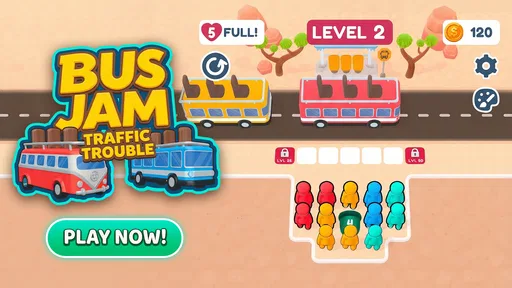
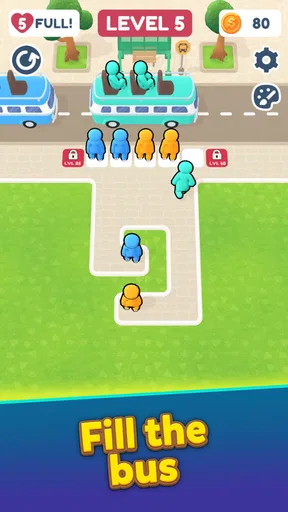
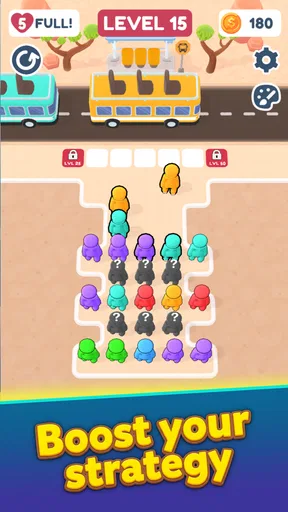
Our Review of Bus Jam: Traffic Trouble
 Analysis by Appyee
I spent time with Bus Jam: Traffic Trouble because its central idea is immediately understandable: sort waiting riders and clear a crowded bus area before the traffic situation becomes impossible to manage. It is a free casual game from Gimica GmbH, and that simple premise makes it easy to pick up when I want a short, low-pressure puzzle rather than a long gaming session.
What makes it worth discussing is not the basic description, but how much the sorting task changes once the board becomes crowded. At first, the challenge feels like a quick visual exercise. Then I started noticing that every move affects the space available for the next one. A choice that looks harmless can leave the wrong group blocking the route, while a slightly less obvious move can open the whole puzzle. That small shift from matching to planning is the reason I kept returning to it.
Sorting is the real challenge, not just moving buses
The most important capability here is the way the game turns passenger sorting into a space-management problem. I am not simply looking for identical colors and tapping until the screen is empty. I have to read the arrangement, decide which riders can be handled safely, and think about whether clearing one area will make the next decision easier or harder.
That distinction matters because casual games often give me a predictable loop that becomes automatic after a few rounds. Bus Jam: Traffic Trouble has a more interesting rhythm when the layout forces me to delay an obvious match. The best move is not always the group I can serve immediately. Sometimes the useful action is the one that creates room, exposes a blocked option, or prevents a later bottleneck.
I found this especially appealing during short breaks. I could play without learning a complicated control scheme, yet I still had something to think about. The game is approachable enough for someone who does not normally play puzzle titles, but it is not completely mindless. The key skill is preserving future options instead of chasing the first available match.
That focus also gives the game a clear identity within the casual category. It is closer to a compact sorting puzzle than to a traditional racing game, transport simulator, or time-heavy strategy title. The bus theme supplies the setting, but the real activity is arranging choices under limited space. Anyone expecting driving, route planning, or a detailed city-management experience should adjust their expectations before installing it.
Why the simple premise stays readable
The visual goal is easy to understand: riders need to be organized and the jam needs to be cleared. I never felt that I needed a tutorial manual to know what the board was asking me to do. That accessibility is one of the strongest parts of the design because it lets the challenge come from the arrangement rather than from unfamiliar rules.
There is also a useful mental separation between the immediate move and the full solution. I can see a possible action quickly, but I still need to ask what it does to the remaining board. That makes each level feel like a small decision tree. I do not need to calculate everything several moves ahead, but I do need to avoid treating every open option as equally good.
For me, this is where the game feels more satisfying than a basic color-matching alternative. A matching game often rewards speed or repeated pattern recognition. Here, the same visual information has a practical consequence: clearing one group can either simplify the board or make it tighter. The difference is subtle, but it gives the bus-jam theme a functional role instead of using it only as decoration.
How a typical session feels in practice
I usually approach a board by scanning the entire scene before touching anything. My first pass is not about solving it; it is about identifying which groups are already close to being useful and which areas look likely to become blocked. This takes only a moment, but it prevents the common mistake of committing to the first attractive move.
After that, I prioritize actions that improve visibility and working space. If a move removes an obstruction while keeping several possible follow-ups open, I prefer it over a move that completes a small group but leaves the rest of the board cramped. This is one of the most practical habits I developed while playing, and it makes the game feel less random even when the layout is busy.
A second useful habit is to think in terms of unfinished commitments. I try not to scatter attention across too many different groups unless the board gives me no choice. When I start several sorting lines at once, I can lose track of which one is actually helping. Keeping one or two clear priorities makes the screen easier to read and reduces careless taps.
The game works well for touch play because the interaction is direct and uncomplicated. I can make a decision quickly, see its effect, and reassess the board. That short feedback loop is important for a mobile puzzle. I do not have to settle into a long session to understand whether I am enjoying myself.
At the same time, the simplicity can expose small moments of frustration. When I misread a crowded arrangement, the result feels like my own mistake, which is fair. But if I am playing while distracted, the compact board can become visually demanding. This is not a game I would choose when I want to play without looking carefully at the screen. Its low learning curve should not be confused with a completely passive experience.
A realistic everyday use case
Imagine waiting for a train or sitting down with a coffee before an appointment. I would open the game for a few minutes, play while fully focused on the current board, and stop as soon as I reached a natural pause. It suits that situation better than a story-driven game because I do not need to remember a plot, manage a large inventory, or rebuild context after putting the phone away.
It is also a reasonable choice for someone who wants a gentle mental warm-up. I can use the first few moments to practice scanning, grouping, and leaving room for later decisions. That does not turn it into a productivity tool, but the game does reward a type of attention that feels more engaging than simply watching short videos.
On the other hand, I would not recommend it for a commute where I expect constant interruptions and cannot safely concentrate. A single distracted action can change the state of the board, and the appeal comes from making deliberate choices. For truly fragmented play, a simpler one-touch arcade game may be a better fit.
Small decisions that make a noticeable difference
My most useful approach is to avoid completing a group just because it is available. I first check whether that completion will leave a useful lane open or create a dead end for another group. This is a non-obvious trade-off: progress on the screen is not always progress toward a solvable board.
I also try to use the edges of the arrangement as reference points. When the center becomes crowded, I look for actions that reduce central congestion rather than merely changing colors. This helps me keep track of what is still accessible. It is a simple visual workflow, but it makes difficult boards feel more manageable.
Another tip is to pause after every meaningful change instead of tapping through a planned sequence too quickly. The board can look completely different after one clearing action. Rechecking the remaining options costs almost nothing, while following an outdated plan can waste the position I just created.
Finally, when I am unsure between two moves, I choose the one that preserves more alternatives. This is not always the fastest route, but it is the safest general rule I found. A move that keeps several groups viable gives me room to recover from a later mistake. A move that locks the board into one narrow line can be efficient only if my reading is perfect.
Where the game fits among casual alternatives
Compared with ordinary match-three games, Bus Jam: Traffic Trouble feels less dependent on chaining quick combinations. Match-three titles usually emphasize repeated board clearing, special effects, and rapid pattern recognition. This game is calmer in its decision-making, with more attention placed on order and available space.
It is also very different from bus-driving games. There is no reason to install it if the appeal of buses for you is steering through streets, following routes, or managing passengers in a simulation. The transport setting is a framework for the sorting puzzle, not an invitation to drive. I appreciate that distinction because it keeps the experience focused, but it also narrows the audience.
Against minimalist sorting games, the traffic-jam presentation gives the task a clearer sense of purpose. I am not just arranging abstract objects; I am trying to restore movement to a congested scene. That theme makes the decisions easier to understand and gives each successful clearing action a satisfying payoff.
The trade-off is depth. Someone who wants a large strategic system, extensive customization, or a long-form campaign may find the format too contained. I see it as a focused casual game for repeated short sessions, not as a replacement for a full puzzle adventure. Its strength is the clarity of one central idea, and that same focus limits how broad the experience can become.
What may frustrate regular players
The biggest limitation is that the core interaction can feel repetitive if I play for too long at once. Sorting groups and opening space is enjoyable, but it is still the same basic mental activity from board to board. I get more from it when I treat it as a short break rather than expecting an all-evening game.
Players who dislike planning under visual pressure may also lose patience. The controls are easy to understand, but the board can demand careful attention. There is a difference between knowing what the game wants and knowing which move will keep the situation under control. That gap creates the challenge, but it can feel unforgiving when I am tired.
Another trade-off is that the bus theme may set expectations the game does not intend to meet. The store summary presents the idea of sorting riders and clearing a jam, and that is exactly the right way to approach it. If I arrive looking for traffic simulation, character progression, or vehicle customization, I am likely to judge it against the wrong standard.
I would also skip it if I need a game that remains satisfying without concentration. Its casual label describes the accessibility, not the absence of thought. For relaxed but attentive play, it works well. For background tapping while doing something else, it is less suitable.
Who gets the most from this game
I think the best audience is someone who likes tidy visual puzzles, short sessions, and decisions that become more interesting as the board fills up. It is particularly suitable for players who enjoy the feeling of turning a messy arrangement into an orderly one. The bus setting adds context without forcing me to learn a complicated world.
It can also work for families because the content rating is Everyone and the objective is easy to explain. A younger player can understand the sorting goal, while an older player can focus on planning several actions ahead. I would still describe the harder moments as attention-based rather than purely relaxing, so the right experience depends on how much concentration the player enjoys.
The game is available free, which lowers the barrier to trying it. Its current version is 1.0.4, and it supports devices running Android 7.0 or later. Those details make it a practical option for people using older compatible Android phones, although the actual comfort of play will still depend on screen size and how clearly the crowded board can be viewed.
Its reception also suggests that it has found a receptive casual audience: the game holds a 4.6 average from around 5.1 thousand ratings, with more than 100 thousand installs. I treat those figures as useful context rather than a guarantee, because the game’s appeal is quite specific. Someone who enjoys sorting and spatial planning may understand the enthusiasm immediately, while a player looking for action may not.
The developer, Gimica GmbH, has kept the concept easy to recognize. That clarity is valuable on mobile, where I often decide within a minute whether a game deserves space on my phone. I know what kind of attention it asks from me, and I know when it is the right choice: a short puzzle break, not a deep simulation session.
My final recommendation after playing
I recommend Bus Jam: Traffic Trouble to anyone who wants a free casual puzzle built around one clear capability: keeping a crowded passenger arrangement under control while opening a path toward a clean solution. Its best moments come from resisting the obvious move, preserving options, and watching a tangled board gradually become workable.
I would not call it a universal recommendation. It is not the right pick for driving mechanics, elaborate progression, or completely mindless tapping. It can also become repetitive during long sessions, and the visual sorting requires more focus than the simple premise might suggest. Those are genuine boundaries, not flaws that disappear with enthusiasm.
For the right player, though, the focus is a strength. I can start quickly, understand the goal, and use a few minutes productively as a small mental reset. My advice is to scan before acting, favor moves that create room, and pause after major changes instead of following a fixed sequence. If that style of puzzle sounds satisfying, this is a compact traffic-sorting game that earns its place among casual mobile distractions.
Verdict
Strengths of Bus Jam: Traffic Trouble
- Simple controls make it easy to start playing immediately.
- Short levels are convenient for quick gaming sessions.
- Colorful visuals make the traffic puzzles pleasant to follow.
- Progression introduces new challenges without overwhelming beginners.
- Offline play is useful when you have no internet connection.
Limitations of Bus Jam: Traffic Trouble
- Difficulty can rise sharply in later levels.
- Repeated layouts may make the gameplay feel predictable.
- Hints or extra moves may be limited without watching ads.
- Frequent ads can interrupt the flow between levels.
- Some stages depend heavily on trial and error.
Other Releases by Gimica GmbH
View All


Similar Picks in This Category
View All
My Talking Angela
Outfit7 Limited4.2

My Talking Tom
Outfit7 Limited4.3

Pou
Zakeh4.2

My Talking Tom 2: Pet Game
Outfit7 Limited4.3

Candy Crush Saga
King4.6

Bridge Race
Supersonic Studios LTD4.1
Frequently Asked Questions
What is Bus Jam: Traffic Trouble, and how is the game played?
Bus Jam: Traffic Trouble is a casual puzzle game centered on organizing buses and passengers in crowded traffic situations. You generally match passengers with buses of the correct color, clear vehicles from the road, and manage limited space while progressing through increasingly complicated levels. The game is easy to understand at first, but later stages require planning, careful ordering, and smart use of available moves.
Is Bus Jam: Traffic Trouble free to download and play?
The game is typically available as a free download, allowing players to begin without paying upfront. However, free gameplay may include advertisements and optional in-app purchases, such as coins, boosters, extra moves, or other helpful items. Before downloading, users should check the current store listing for the exact pricing, advertising policy, and whether purchases can be disabled through their device settings.
Does Bus Jam: Traffic Trouble require an internet connection?
Many puzzle levels can usually be played without a constant internet connection, which makes the game convenient for short sessions while traveling or when mobile data is unavailable. Nevertheless, an internet connection may be needed for advertisements, rewards, cloud features, updates, or certain events. Offline availability can vary between versions, so it is best to test the game after installation rather than assume every feature works offline.
Is Bus Jam: Traffic Trouble suitable for children?
Bus Jam: Traffic Trouble uses simple controls, colorful visuals, and straightforward matching mechanics, making it accessible to a broad audience, including younger players. Even so, parents should review the age rating, advertising content, and in-app purchase options before allowing children to play. Difficulty, promotional offers, and online features may differ by region, device, or game update, so parental controls are recommended.
Are there boosters or purchases, and can the game become difficult?
The game is designed to start with relatively simple traffic and passenger puzzles before introducing tighter spaces, more buses, and trickier sequences. When a level becomes challenging, players may be offered boosters, hints, extra moves, or other resources, sometimes through gameplay and sometimes through optional purchases. These items are not always necessary, but they can affect progression and may encourage spending during difficult stages.
Play our best games!


